


By Amanda Clegg, Relationship Coach, CNEP, CLC
Reading Time: 4 minutes
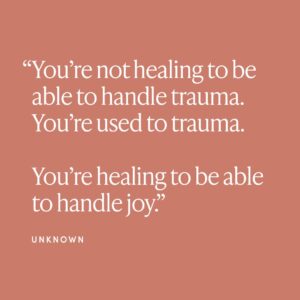
I heard a quote that really spoke to me and I often share it with my clients, “You’re not healing to be able to handle trauma. You’re used to trauma. You’re healing to be able to handle joy.”
The title “The Fear of Joy” might sound strange, but I see it often. The quiet fear many of us carry. The one that (in my opinion) doesn’t get talked about nearly enough…
The one that says:
What if things go well?
Not in a rom-com kinda way. Not in a winning-the-lottery kinda way. But in a steady, grounded, “My life actually feels okay” kinda way.
This kind of happiness can actually feel more threatening than sadness or pain. I know, it seems odd. It’s akin to when the fear of anger comes up with clients and my response is, “I love anger!”…kinda weird too (especially without context) but if you want to hear what I mean re: anger, check out this blog.
When Joy Feels Unsafe
For many of us, joy isn’t neutral. It’s loaded.
Joy can mean:
- Something bad is about to happen
- I’m going to lose this
- I don’t deserve this
- If I relax, I’ll get blindsided
If you grew up in (or have experienced in life) chaos, inconsistency, trauma, or emotional unpredictability, your nervous system may have learned a simple equation:
Calmness = danger
From a nervous system perspective, this makes sense. Your body adapted to stay alert because alertness once kept you safe (or, not being alert made you unsafe).
Hypervigilance became competence.
Bracing became normal.
Joy, then, wasn’t a place to land. And it sure wasn’t a place to stay. Joy was just a quick pause before impact. So, now, when life starts to feel good, something inside of you tightens instead of softens. You may not consciously think, “I’m afraid to be happy”, but your body might be saying, “This feels unfamiliar…stay sharp.”
How the Fear of Joy Self-Sabotages
The fear of joy doesn’t usually show up waving a big red flag. It’s subtle. Sneaky. And verrrrry convincing.
It sounds like:
- “I’ll just keep my expectations low.”
- “I don’t want to jinx it.”
- “Let me wait until I’m sure.”
- “This probably won’t last anyway.”
- “Is it OK to feel this way?”
I hear a variation of these words in session with clients, usually slipped in quietly…and could pass without a pause until we learn to hear it.
It looks like:
- Pulling away when things are good
- Overthinking yourself out of joy
- Procrastination on the things you want most
- Choosing familiar pain over unfamiliar happiness
- Downplaying achievements, compliments, or good moments
The myth we tell ourselves is that if we stay guarded, we’ll be safer. But trying to protect ourselves from future pain by avoiding happiness doesn’t actually keep us safe. It keeps us stuck.
Pain happens. Loss happens. Disappointment happens. Avoiding joy won’t stop any of it, it only makes us suffer ahead of time. But what if we didn’t have to live in that constant preemptive suffering?
Joy is often misunderstood. It’s not a permanent state, nor is it proof that nothing bad will happen or a reward for being “good enough”. Joy is a moment of alignment with your life as it is right now. You don’t have to believe it will last forever to let it exist in this moment. You are allowed to enjoy things without securing their future.
How To Gently Stop Sabotaging Yourself
This isn’t about forcing positivity or choosing happiness through gritted teeth. It’s about building tolerance for goodness.
- Name the fear without judging it: Instead of arguing with yourself or shaming yourself, experiment with curiosity. “Something in me is afraid of this going well. That makes sense.”
- Practice letting joy be temporary: You do not have to commit to joy forever. Try, “I can let this moment be good.”
- Notice when you’re about to pull the plug on a pleasant moment: Right before you sabotage, pause and ask “Am I responding to a real problem or an old pattern that equates safety with struggle?”
- Building capacity for ease (AKA tolerance for joy…my FAVORITE method): For many therapy and coaching clients, the issue isn’t accessing joy, it’s staying with it. If your nervous system is used to intensity, urgency, or problem-solving, ease can register as boredom, guilt, or danger. This is why good moments can feel oddly uncomfortable. Instead of chasing joy, we build a tolerance for joy. This could look like letting a compliment land without deflecting or minimizing it, noticing a calm day and resisting the urge to manufacture a problem, allowing support or help, pausing for 10 extra seconds in a moment of contentment. Each time you stay present with something good, you teach your body that it is safe to feel okay.

Let joy be a practice. An experiment.
I think it’s time for our nervous systems to move out of surviving and into savoring.
Over time, this practice becomes a way of being. A new normal. One that feels like you.
Love & gratitude,
Amanda


Amanda works with couples and individuals who want to build secure, connected relationships – both within themselves and with the people they love. Using the Enneagram as a powerful framework for awareness and growth, she helps clients understand their patterns, soften reactivity, and create new ways of relating rooted in compassion and emotional safety.

